Loss of Tail Rotor Effectiveness
LTE is an aerodynamic condition where the tail rotor cannot produce enough thrust to overcome torque, resulting in an uncommanded yaw. It is not a mechanical failure — the tail rotor is fine. The aerodynamic environment around it has degraded to the point where the same pedal input produces less anti-torque thrust than expected. Three risk factors: low airspeed, high power, and wind from a problem direction. Required reading: FAA AC 90-95.
Also called: unanticipated yaw, "the spinning incident"
The three risk factors
LTE develops when several conditions overlap:
- Low airspeed (under ~30 knots) — no tail-fin weathervaning effect, no clean airflow into the tail rotor disc, no relative wind to help anti-torque effectiveness.
- High power setting — high collective means high torque, which means the tail rotor has to produce a lot of thrust just to break even.
- Wind from a critical direction — see next section.
Add high density altitude or high gross weight and you've narrowed the margin further. None of these is unsafe alone; combined, they remove your reserve.
The four critical wind regions (US CCW rotor)
For helicopters with a CCW main rotor (most US designs):
- Main rotor disc vortex interference — wind from approximately 285° relative (left front quartering) directs main rotor tip vortices into the tail rotor disc. The tail rotor sees disturbed, swirling air and produces erratic thrust.
- Weathercock instability — wind from 120° to 240° relative (the rear half of the helicopter) lacks the weathervaning stabilization that helps keep the nose into the wind. Yaw rates can build quickly.
- Loss of translational lift — the entire low-airspeed regime, where the rotor isn't getting clean translational airflow.
- Tail rotor vortex ring state — wind from approximately 210°–330° relative (left side / tail) can push the tail rotor into its own VRS, where it descends into its own thrust column. Pedal input doesn't produce expected response.
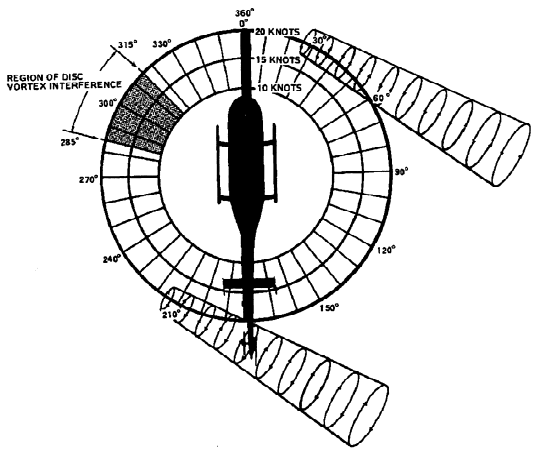
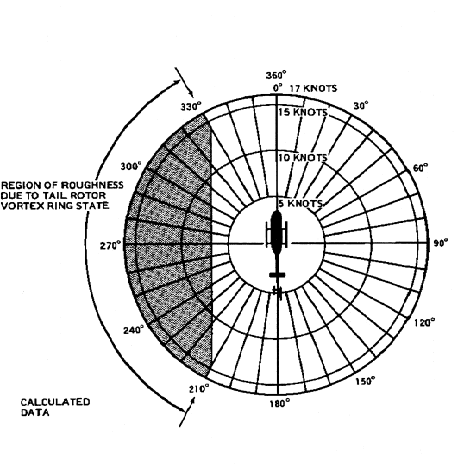
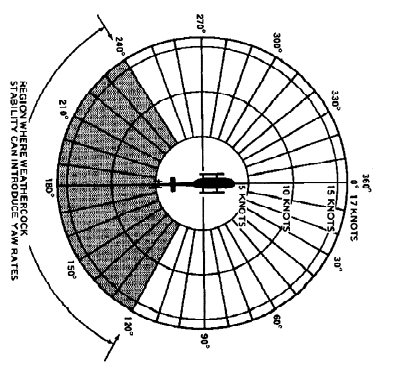
You don't need to memorize the degree numbers exactly. Memorize the principle: winds from the left and rear of a US helicopter degrade tail rotor performance. The right side (where the tail rotor is producing leftward thrust into clean air) is generally safe.
Recognition and recovery
LTE is recognized by an uncommanded yaw — typically a right yaw on a US helicopter — that increases despite full opposite (left) pedal. The yaw rate may build quickly.
Recovery, in order of priority:
- Apply forward cyclic to gain airspeed. Translational lift restores tail rotor effectiveness almost immediately once you reach ETL.
- Reduce collective if necessary. Less power = less torque = less anti-torque demand. Don't reduce so much that you can't fly out, but unloading the tail rotor helps it recover.
- Apply full anti-torque pedal (left for US helicopters) and hold it. Don't pump pedals — that disrupts whatever effectiveness remains.
- If the spin is uncontrollable, autorotate. With no engine power, there's no torque to counter, and the helicopter stops spinning.
The forward-cyclic priority is critical. The single most reliable cure for LTE is airspeed.
Prevention — the operational discipline
Almost every LTE accident is preceded by ignoring at least one risk factor:
- Hovering with a tailwind in a confined area instead of repositioning into the wind.
- Hovering OGE at high gross weight on a hot day without verifying tail rotor authority margin.
- Power-on pedal turns at high collective, especially in gusty conditions.
- Photo or sling load operations at slow airspeed near terrain.
- Hover-taxi with a left crosswind without anticipating reduced tail rotor effectiveness.
The operational rule: at low airspeed and high power, point the nose into the wind whenever possible. If wind direction shifts, reposition. If you can't reposition, accept that you're operating in degraded tail rotor margin and reduce gross weight or abort.
The "not a mechanical failure" point matters
Pilots sometimes confuse LTE with tail rotor mechanical failure. They are not the same thing:
- LTE — pedals work, tail rotor is intact, but the airflow environment doesn't let the tail rotor produce enough thrust. Recovery is aerodynamic (gain airspeed).
- Tail rotor failure — drive shaft, gearbox, or blade failure. Pedals don't work because there's no drive to the tail rotor. Recovery is autorotation.
The diagnostic clue: in LTE, full anti-torque pedal still produces some response. In tail rotor failure, pedal inputs do nothing or produce inconsistent response. If you're uncertain, treat it as the worse case — autorotate.