Tail Rotor Failure
A mechanical failure in the tail rotor system — drive shaft, gearbox, blades, or pitch-change mechanism — produces one of two very different scenarios depending on whether thrust is lost or stuck. The recovery for each is different, and the airspeed at the time of failure determines what's available to you. This is the structural counterpart to LTE, which is purely aerodynamic.
Two failure modes — they require different responses
"Tail rotor failure" is a category, not a single scenario. The two main modes:
- Loss of tail rotor thrust — the tail rotor is producing zero or near-zero thrust. Causes include drive shaft failure, gearbox failure, blade departure. The aircraft yaws toward the direction of torque (left for a counter-clockwise main rotor, right for a clockwise rotor) and continues yawing as long as power is applied to the main rotor.
- Stuck pedal / fixed-pitch failure — pitch link or actuator failure leaves the tail rotor producing some fixed amount of thrust. Yaw rate depends on whether the stuck pitch is more or less than what's needed at the current power setting.
This page covers complete loss of thrust. Stuck-pedal failures are aircraft-specific and covered in your POH supplements.
Distinguish tail rotor failure (mechanical) from LTE (aerodynamic). LTE happens in flight regimes where the tail rotor can't make enough thrust; the system is intact and recovery is by airspeed and pedal management. A real TR failure means the system is broken and pedals do nothing useful.
The three classic LTE wind regions on a US (counter-clockwise) main rotor — covered in depth on the LTE page — are what an unanticipated yaw without a mechanical failure can look like:
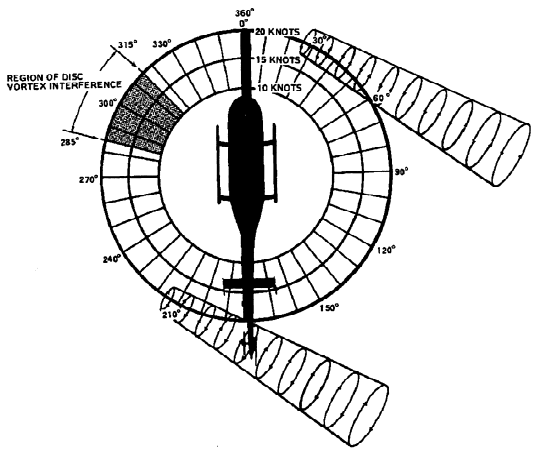
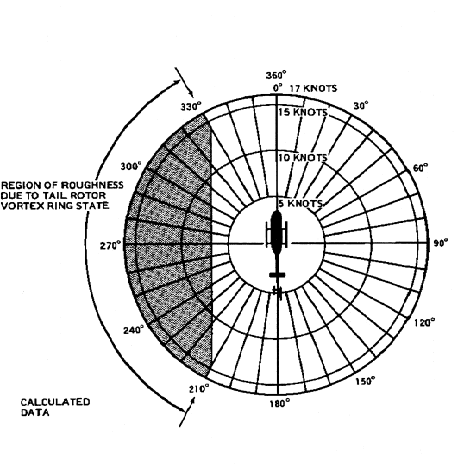
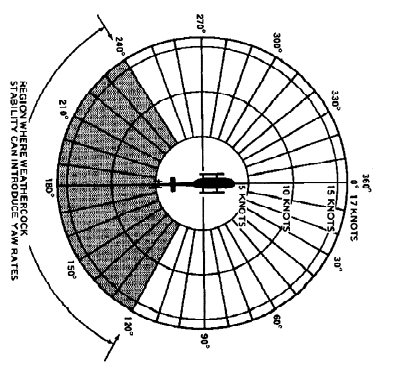
Loss of tail rotor thrust — in hover or low-speed flight
This is the worst case: low altitude, low airspeed, and a yaw rate building immediately. Recovery options are limited.
- Lower collective immediately to reduce torque demand. Less torque means less yaw acceleration. This is the same first action as engine failure, and for the same reason — it buys time.
- If altitude permits, enter a low-speed autorotation. With the engine disconnected from the rotor (throttle to idle), there is no torque reaction for the tail rotor to balance.
- If on or near the ground, reduce collective to land immediately. A spinning-on-the-skids touchdown is bad but survivable; a high yaw rate at altitude is not.
The hover is the regime in which a tail rotor failure is most dangerous and least recoverable. Helicopters with low-altitude hover-IGE training profiles are deliberately practiced near the ground for this reason — to compress the recovery distance.
Loss of tail rotor thrust — in forward flight
At cruise airspeed, the vertical fin produces a weathervane effect that helps keep the nose into the relative wind. The aircraft is no longer fighting unopposed torque alone; aerodynamic surfaces are helping.
- Maintain airspeed — most POHs publish a "no tail rotor thrust" airspeed (often 60–90 KIAS) at which the airframe naturally streamlines. Below it, the weathervane stops working; above it, blade flapping and other limits become a concern.
- Reduce power as airspeed allows — less torque means less yaw correction needed from the airframe. The airspeed-and-power combination that gives you near-zero yaw rate is the one to fly.
- Plan a run-on landing. Do not attempt to slow to a hover — the moment you bleed below airspeed-effective range, the yaw will return. Touch down with forward speed, slide the helicopter to a stop on its skids.
Surface choice matters: a runway, taxiway, or smooth grass strip is ideal. Soft, uneven, or sloped surfaces can grab a skid during the slide and induce dynamic rollover. If the surface is questionable, accept a longer slide on the best terrain available rather than touching down short on rough ground.
What the failure feels like
Recognizing TR failure quickly is half the battle. Symptoms:
- Sudden, uncommanded yaw — usually toward the torque direction, which feels different from a coordinated turn.
- Pedal authority gone — the pedal you'd normally apply does nothing, or far less than expected.
- Possibly unusual noise or vibration — depending on the failure mode, you may hear or feel the tail rotor departing or the drive shaft snapping.
- Possibly attitude change — a tail boom strike or severe yaw can cause the airframe to roll or pitch.
Compare to LTE: that has gentler onset, depends on flight regime, and responds to coordinated airspeed-and-pedal recovery. TR failure is abrupt and the pedals don't help.
Aircraft variation matters
How a tail rotor failure looks and behaves depends heavily on rotor system layout and aircraft design. A few examples worth knowing:
- Tractor vs pusher tail rotors — the geometry differs and therefore the failure modes do too.
- NOTAR systems (Coanda effect, e.g. MD 520N) replace the tail rotor with directed airflow. Failure modes are completely different.
- Fenestron tail rotors (ducted fan, e.g. EC-120) have somewhat different failure characteristics again.
- Rotor direction — counter-clockwise (US-built, most piston trainers) yaws left under torque; clockwise (most European designs, Airbus single-engine helicopters) yaws right.
Know your aircraft. The Cabri G2 has a clockwise main rotor — its TR failure is a right yaw, opposite of the Robinson's left yaw, and the recovery pedal is the opposite. Memorizing one aircraft's responses doesn't transfer.